Somewhere between a plain dotted notebook full of task lists and a fully illustrated, Pinterest-worthy spread sits a question most bullet journallers eventually ask themselves: am I doing this right? The honest answer is that there isn’t one right way to keep a bullet journal. There is, though, a version of it that will actually stick for you long-term, and figuring out where you naturally land between “purely functional” and “fully decorative” is the fastest way to find it.
This isn’t about picking a side and staying there forever. It’s a quick way to work out what your journal should actually look like, so you stop borrowing a style that doesn’t fit and start building one that does.
📏 The Two Ends of the Spectrum
At one end is the functional journaller. Their spreads are built around trackers, task lists and rapid logging. If decoration shows up at all, it’s a single highlighter line under a deadline, nothing more.

Crafting Her Plans
Ready to plan it all out? We’ve got you.
Head over to the shop for printable planners and journals you can download and start using today.
Browse the shop →At the other end is the fully decorative journaller, for whom the spread itself is the point. Washi tape, hand lettering, stickers and colour washes aren’t extras added on top of the plan. They are the plan, and making the page is often just as valuable as using it afterwards.
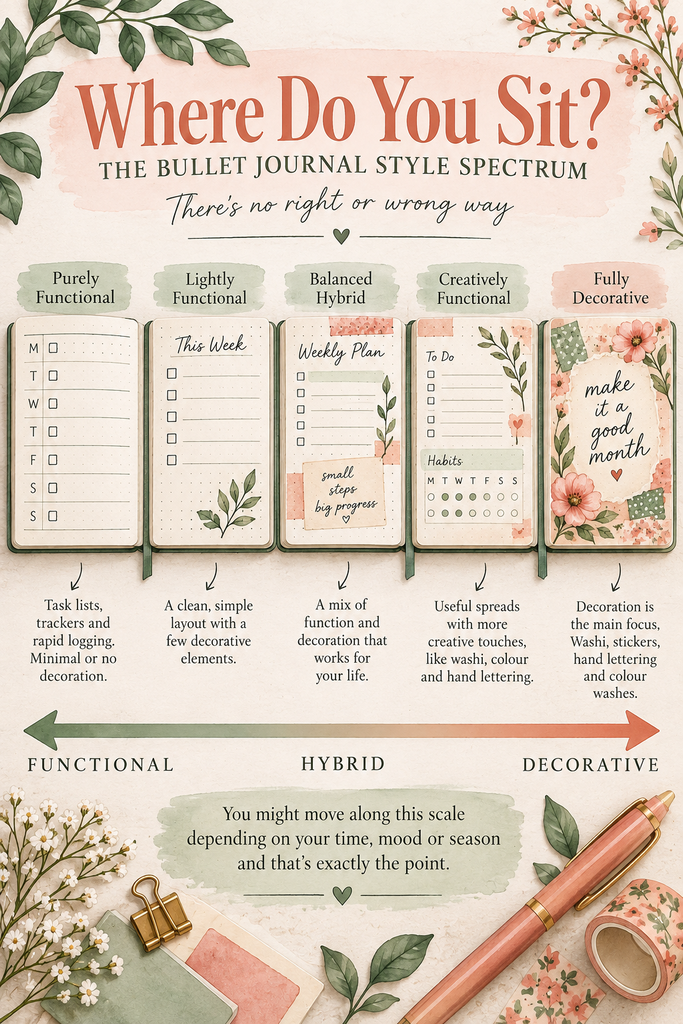
Almost nobody lives neatly at either extreme. But knowing which pull is stronger in you changes how you should set your journal up, so it’s worth being honest about where you actually sit before you copy someone else’s layout from Pinterest or Instagram.
It’s also worth remembering that most of what you see online sits closer to the decorative end simply because it photographs better. A five-minute functional grid rarely goes viral, even though it’s exactly what keeps plenty of journallers consistent for years. Don’t mistake what’s most visible for what’s most common, or most effective.
⏱️ Signs You Lean Functional
A few signs you’re closer to the functional end of things:
- You’re short on time and need a system that works in under five minutes a day
- Consistency matters more to you than how the page looks
- You’d rather duplicate a simple layout every week than design something new each time
- A tracker only feels “done” once you’ve actually used it, not once you’ve decorated it
If that sounds familiar, a sticker-based functional system is worth setting up properly. Sticker Kit Essentials for FUNctional Spreads walks through exactly which pieces are worth stocking, and FUNctional Sticker Spreads: The Complete Guide to Sticker-Based Planning covers the full method from the ground up. A functional planner sticker multi-pack gives you pre-cut trackers, icons and habit dots, so the design work is already done and every minute goes into actually using the page.
🎨 Signs You Lean Decorative
On the other end, decorative journalling might be your natural home if:
- Journalling is your creative outlet or wind-down time, not just a planning tool
- You enjoy the process even when it takes forty minutes instead of four
- You’ve bought supplies, stickers, washi, a new pen, simply because they were pretty, not because you needed them
- A blank page feels like an invitation rather than a chore
If that’s closer to home, lean into it rather than fighting it. Junk Journaling vs Scrapbooking: What’s the Difference? is worth a read if you’re not sure which decorative format actually suits how you work, and 5 Best Journals for Art Journaling and Mixed Media rounds up notebooks built to handle heavier decorative media without the pages buckling. A pair of deckle-edge craft scissors is a small, inexpensive way to make cut or layered ephemera look intentional rather than accidental.
🤝 Most of Us Are a Hybrid, and That’s the Point
If neither list fully describes you, that’s normal. Most journallers sit somewhere in the middle, and the goal isn’t to force yourself into a “team” but to find your own mix.
A hybrid approach usually looks like a simple functional grid for the pages that need to actually work, tasks, trackers, appointments, paired with one or two pages a week where decoration is allowed to take over. Some people keep their weekly spread strictly functional and let a monthly cover page or a seasonal reflection spread go fully decorative. Others flex with their week: a strict minimalist layout during a hectic stretch, then a slower, more illustrated version when they have the time and headspace for it.
The system is meant to bend around your life, not the other way round. If you’re constantly forcing a heavily decorated spread into a week that has no time for it, the journal stops being useful and starts being another task on the list.
A useful rule of thumb: let the pages that carry real consequences, appointments, deadlines, bills, stay functional and quick to scan. Save the decoration for pages where a slower pace doesn’t cost you anything, like a monthly reflection, a gratitude log or a seasonal mood board. That split lets you keep the parts of the system that genuinely need to work reliable, while still giving yourself somewhere to enjoy the process.
✏️ A Quick Example Spread for Each Style
Functional example: a simple weekly grid, seven columns, one per day, with three rows underneath for top tasks, a habit tracker strip along the bottom, and nothing else. No washi, no hand lettering. It can be set up in under five minutes and reused every single week without redesigning it.
Decorative example: a full-page monthly cover with a hand-lettered title, a watercolour wash or collage background, a small illustrated element tied to the season, and just one or two functional elements tucked into a corner, like a mini habit tracker or a short goals list. The page takes time, but it’s meant to. It’s the one spread in the month that’s allowed to be slow.
Neither is “more legitimate” than the other. A five-minute functional grid that you actually fill in every day is doing its job just as well as a decorative spread that gets you excited to open the notebook.
🧠 How to Test It in Real Life
If you’re still not sure which way you lean, don’t try to decide it on paper. Run a two-week experiment instead.
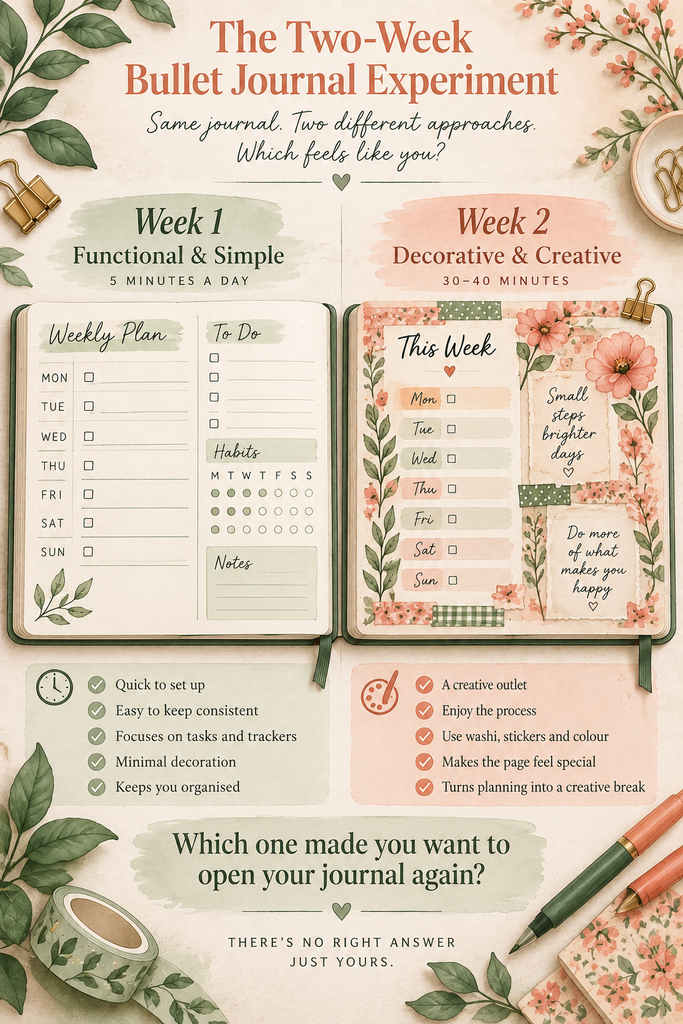
For week one, set up the plainest, most functional spread you can manage. Grid only, no decoration, five minutes tops. Notice how it feels to open it each morning. Does it feel calm and efficient, or does it feel flat and uninspiring?
For week two, go the other way. Give yourself permission to spend thirty or forty minutes on a single decorative spread, even if that means the rest of the week’s pages are sparse. Notice whether that time felt like a treat or like a chore you were avoiding.
Most people know within those two weeks. The version that made you want to open the notebook again the next day is the one worth building your system around, regardless of which one you expected to prefer going in.
❓ Quick Questions
Can my style change with the seasons? Yes, and for a lot of journallers it does. A busier autumn term might call for a stripped-back functional layout, while a quieter January can leave more room for a decorative monthly spread. Treat the spectrum as somewhere you move along, not a box you’re locked into.
Do I need expensive supplies to go decorative? No. A single sheet of stickers, a couple of washi tape rolls and one nice pen are enough to start. The point is whether the process itself appeals to you, not how much you’ve spent on it.
Will a functional spread look boring? Not necessarily. A clean grid in a colour you like, with tidy handwriting and consistent spacing, has its own kind of appeal. Functional doesn’t have to mean plain, it just means the decoration takes a back seat to the system actually working.
What if I start decorative and lose momentum halfway through the month? This is one of the most common reasons journallers abandon the habit altogether, and it’s usually a sign the balance has tipped too far towards decoration for the season you’re in. Rather than giving up on the journal entirely, strip the current spread back to a bare functional grid for a week or two. Once the habit feels steady again, you can reintroduce decoration a little at a time rather than diving straight back into a full illustrated spread.
🌟 Where to Go From Here
If you came out of this leaning functional, 5 FUNctional Spreads You Can Set Up in Under 10 Minutes has ready-to-copy layouts so you’re not starting from a blank page. If you’re still working out the basics of the method itself before deciding which direction to take it, Bullet Journal 101: The Perfect Way to Organise Your Life is the place to start.
Wherever you land, the point of a bullet journal was never to look a certain way. It was to actually get used. Build yours around what makes that true for you, functional, decorative, or the hybrid most of us end up with, and it’ll stick a lot longer than a system borrowed from someone else’s feed.