Some weeks, an elaborate spread just isn’t happening, and that’s okay. When time is tight, “functional over fancy” isn’t a compromise, it’s honestly the better approach, since a spread you can actually finish setting up is worth more than one that stays half-drawn in your planner for three days. These five are built for exactly that kind of week.
None of them need a printer, a pair of scissors, or any careful arranging. Each one is designed to go from blank page to finished in the time it takes your coffee to cool down, so there’s no excuse to skip planning altogether just because the week got away from you.
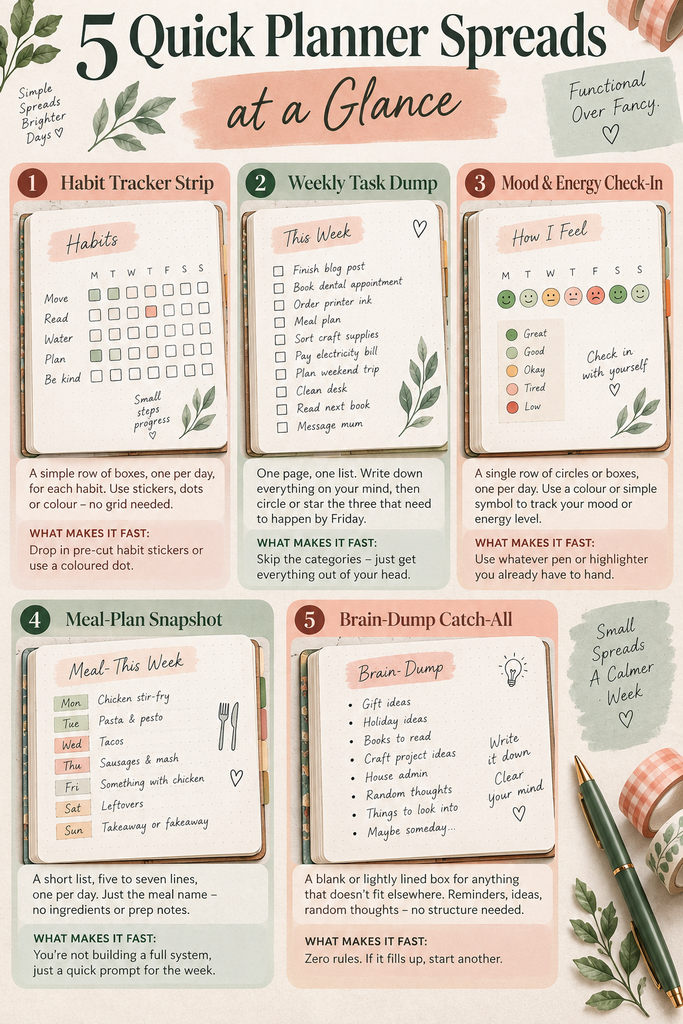
⏱️ Habit Tracker Strip
Draw a single horizontal row of small boxes along the bottom of your weekly spread, one box per day, one row per habit you’re tracking. No grid, no fancy dot layout, just a strip.

Crafting Her Plans
Ready to plan it all out? We’ve got you.
Head over to the shop for printable planners and journals you can download and start using today.
Browse the shop →What makes it fast: pre-cut habit stickers from a functional sticker sheet drop straight into each box, so there’s no freehand drawing involved at all. If you don’t have habit-specific stickers on hand, a single dot sticker in a colour you’ve assigned to each habit works just as well, and you can track anywhere from two to five habits in the same strip without redrawing anything.
📋 Weekly Task Dump
One page, one list, no categories. Write down everything on your mind for the week in the order it occurs to you, then circle or star the three that actually need to happen by Friday.
What makes it fast: skipping the categorisation step (work versus home versus errands) is what saves the time here. You can always mark items with a small symbol as you go if you need a rough sort, but don’t sit down and pre-plan the categories before you start writing.
This one works best written quickly, almost stream-of-consciousness, rather than carefully composed. The goal is to get everything out of your head and onto the page, not to produce a tidy, well-organised list on the first pass.
🌤️ Mood and Energy Check-In Row
A single row of small boxes or circles, one per day, where you note your general mood or energy level with a colour or a simple symbol. Nothing more detailed than that.
What makes it fast: use whatever colouring tool is already sitting on your desk rather than reaching for a specific set. A quick scribble in whatever pen you already have out takes ten seconds; hunting for the “right” colour takes considerably longer and defeats the point of a fast spread. Looking back at a full week of these little marks can also be genuinely useful on its own, even without any deeper analysis, since patterns tend to jump out at a glance.
🍽️ Meal-Plan Snapshot
A short list, five to seven lines, one per day, with just the meal name. Skip the ingredients, the grocery list, and the prep notes entirely for this version.
What makes it fast: you’re not trying to build a full meal-planning system here, just enough of a prompt so you’re not standing in front of the fridge at 5pm with no plan. If you want the fuller version with ingredients and grocery lists, that’s a different, longer spread for a week when you have more time. Even a vague entry like “something with chicken” or “leftovers” counts, the point is having a starting thought already on the page rather than none at all.
🧠 Brain-Dump Catch-All
A blank or lightly lined box somewhere on the page for anything that doesn’t fit your other spreads that week, random reminders, half-formed ideas, things you don’t want to forget but don’t need to schedule.
What makes it fast: the entire point is zero structure. Don’t be tempted to add categories or headers to this one, since a brain dump with rules stops being a brain dump and turns into another task that has to be done properly. If the box fills up before the week’s out, just start a second one below or on the facing page rather than trying to squeeze everything in.
🔀 Mixing These Into a Single Spread
You don’t have to choose just one of these. On a genuinely packed week, it’s worth combining two or three onto a single page rather than treating each as its own spread: the habit strip along the bottom, the task dump taking up the main body of the page, and a small brain-dump box tucked into a corner.
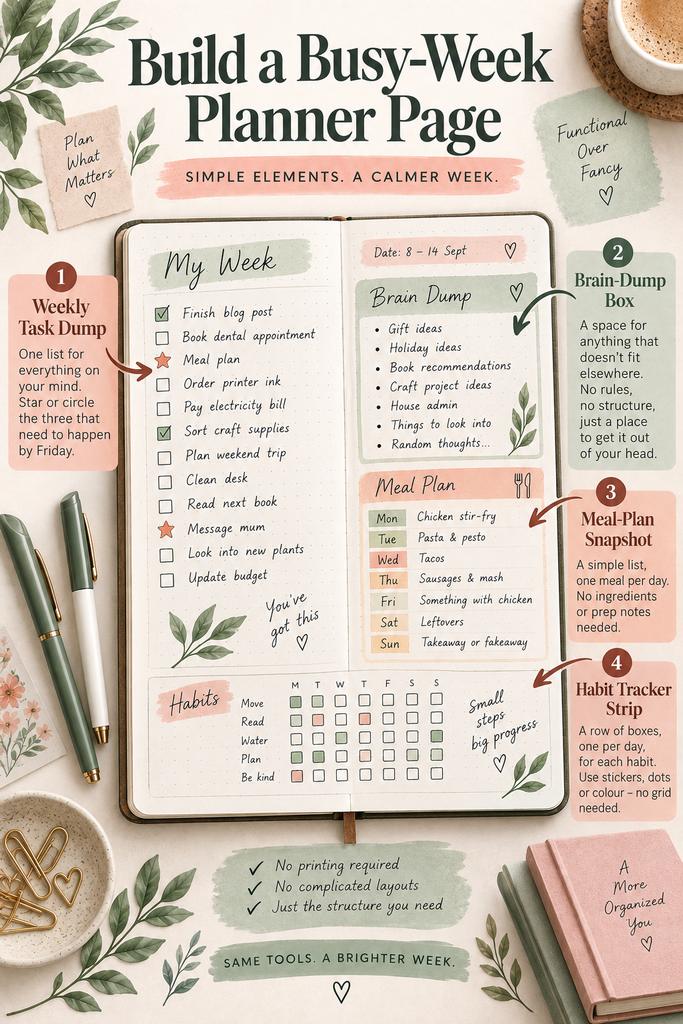
The rule that keeps this fast is the same one that makes each spread work on its own: don’t add structure you don’t need. A combined page still only takes a few minutes if you’re pulling from the same short list of quick elements above, rather than trying to design something new from scratch.
Supplies Worth Having on Hand
None of these five need printing, cutting, or elaborate arranging, that’s the whole idea. A functional planner sticker multi-pack covers most of what’s used above, particularly for the habit tracker strip, without you needing to hunt down individual sticker sheets.
If you want the fuller picture on what’s actually worth keeping in a functional sticker kit, our guide to sticker kit essentials for FUNctional spreads goes into that in more depth than makes sense to repeat here.
When You Want More Than Speed
These five are deliberately narrow, built for weeks when ten minutes is genuinely all you’ve got. When you do have more time and want to see the fuller range of what sticker-based functional planning can look like, our complete guide to FUNctional sticker spreads covers the full breadth: more elaborate layouts, colour-coding systems, and spread types that go well beyond these five quick versions.
Functional doesn’t require elaborate to be worth doing. Some weeks call for the fuller spread, and plenty of others just need something that gets the job done in the time you actually have.