I have bought planners in the wrong size more than once. One was gorgeous but too big to carry, so it lived on my desk and I stopped writing in it by week three.
If you are standing in front of a shelf of A5, A6, B6 and “personal” planners wondering which one is yours, I am working it out right alongside you. This guide starts with how you actually use a planner, and only then points you towards a size.
🎒 Start With Where Your Planner Lives
Before you look at a single measurement, ask where the planner will spend most of its time. That one answer rules out more sizes than any chart.

Crafting Her Plans
Ready to plan it all out? We’ve got you.
Head over to the shop for printable planners and journals you can download and start using today.
Browse the shop →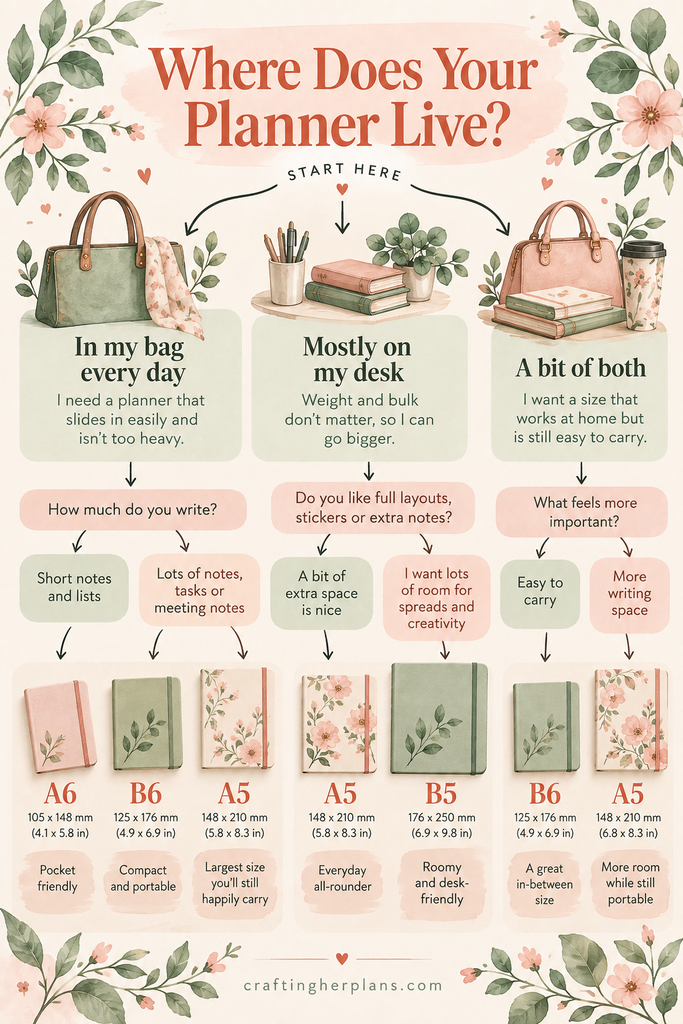
If it goes in your bag every day, you want something that slides in without a fight. If it sits open on your desk, you can afford a bigger page.
- Carried daily: smaller and lighter wins, because a planner left at home is a planner you do not use.
- Desk only: go bigger, since weight and bulk stop mattering.
- Both: pick the largest size you will still happily carry. Be honest here.
I find it helps to picture an ordinary Tuesday. Where is the planner at 8am, at lunch and at 9pm?
✍️ How Much Do You Write?
Size is really about writing space. A small page forces tiny handwriting or short entries, and that suits some people very well.
Tiny, neat lists and one-line appointments? A compact page will feel tidy and calm. Big handwriting, long to-do lists, notes from meetings? You will feel cramped on a small page within days.
A quick test: write your usual weekly plan on a scrap of paper cut to the size you are considering. If you run out of room by Wednesday, size up.
⏱️ A 60-Second Decision Path
If you want a shortcut, run through these four steps in order. Stop as soon as one gives you a clear answer.
- Does it have to fit in a small bag or a coat pocket? If yes, look at A6 or a compact ring size.
- Do you write more than a few lines a day? If yes, skip the smallest sizes and start at B6 or A5.
- Do you plan with stickers, trackers or little doodles? If yes, lean towards A5, B5 or Half Letter.
- Is the planner staying on your desk? If yes, you have the freedom to go as big as you like.
Most people get their answer by step two. If you reach step four and still feel unsure, that usually means two sizes would both work, and that is a good problem to have.
🎨 Do You Use Stickers and Spreads?
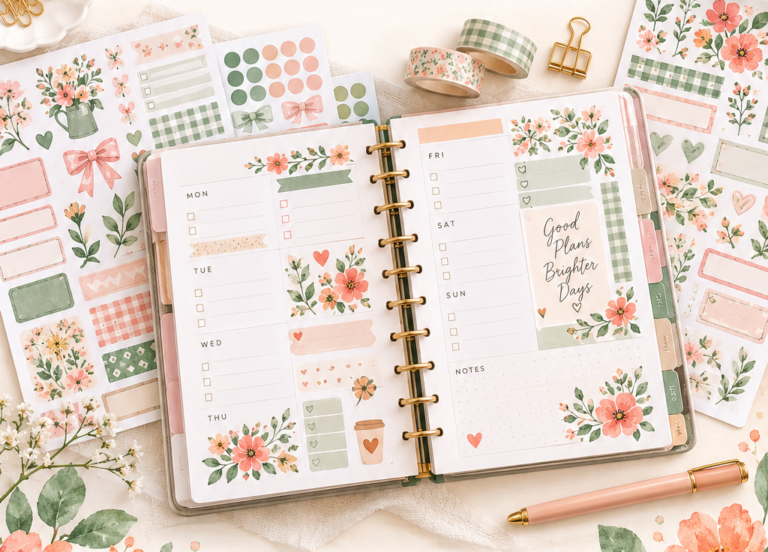
This is the question that changed my own choice. Stickers need physical room, and so do layouts with boxes, trackers and little doodles.
Functional sticker planning works best with a bit of breathing space on the page. If that is how you like to plan, my FUNctional Sticker Spreads guide shows how much room a typical layout needs. And if you are short on time, these spreads you can set up in under 10 minutes work on most mid-sized pages.
Sticker-heavy planners tend to feel happiest at a mid to large size. A multi-pack of functional planner stickers is a handy way to test whether a smaller page can cope before you commit.
📏 The Main Size Families in Plain Terms
Planner sizes come from two naming systems, and that is where most of the confusion starts. The ISO “A” and “B” sizes are used across the UK and Europe, while Letter-based sizes are common in the US.
Here is the quick version, from smallest to largest:
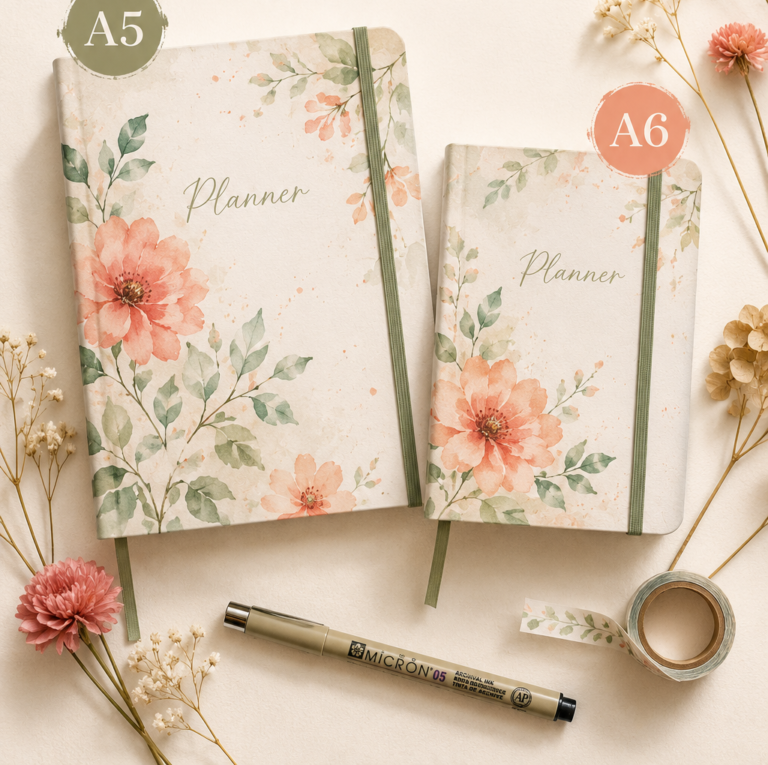
- A6: roughly postcard sized, about 105 x 148 mm (4.1 x 5.8 in). Pocket and handbag friendly, with limited writing room.
- B6: slightly bigger than A6, about 125 x 176 mm (4.9 x 6.9 in). A nice in-between that is less common in shops.
- A5: about 148 x 210 mm (5.8 x 8.3 in). The all-rounder, and the size most people end up with.
- B5: about 176 x 250 mm (6.9 x 9.8 in). Roomy and desk-friendly, but heavy in a bag.
- Half Letter: 5.5 x 8.5 in, the US cousin of A5 and very close in feel.
- Letter: 8.5 x 11 in. Generous space, best kept on a desk.
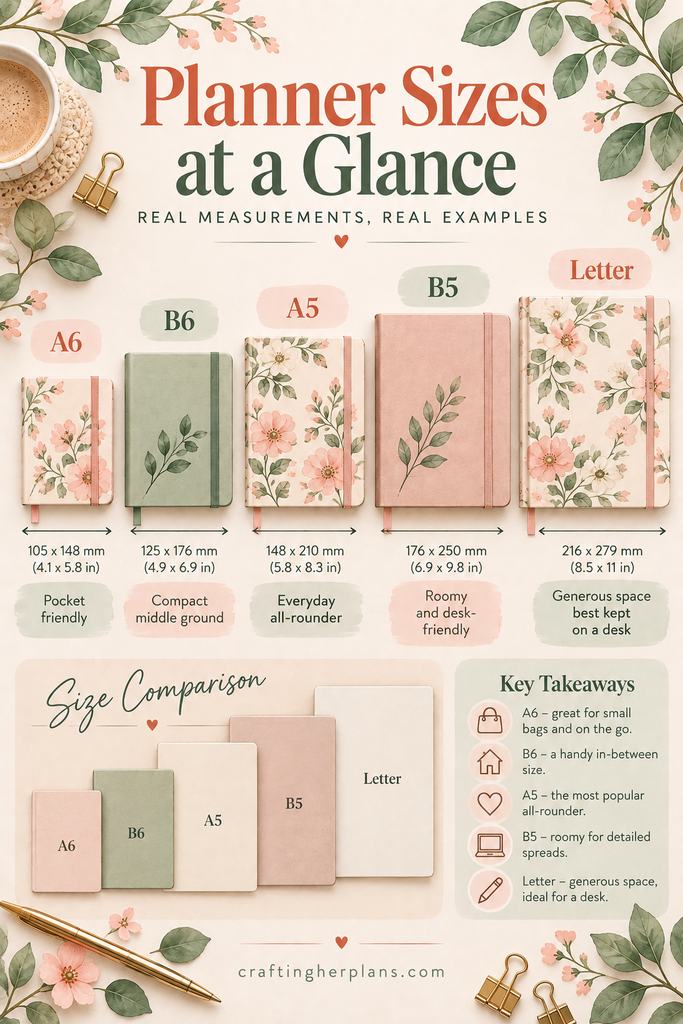
Ring-bound planners add another layer of names, such as “personal”, “pocket” and “compact”. These are brand-specific, and the same name can mean slightly different sizes from one maker to the next. Always check the actual measurements before you buy.
For a fuller reference chart, my planner sizes post lays them all out side by side.
⚖️ How Size Changes Your Planning
Each size family nudges your habits in a particular direction. Seeing that helped me stop blaming myself when a planner did not work out.
Writing space. Smaller pages mean shorter entries and more discipline about what makes the list. Larger pages invite journalling, notes and bigger layouts.
Portability. The bigger the planner, the more often it gets left behind. A planner that stays home cannot catch your plans on the go.
Stickers and layouts. Sticker sheets are designed around certain page sizes, so a very small page can leave you trimming everything down.
Weekly layout. A tiny page with a full week on two sides gives each day very little room. If you like a daily-heavy approach, size matters even more, and my post on choosing between a daily, weekly or monthly planner is a good companion read.
🧪 Try Before You Buy
A planner is a small investment, but a wrong guess still stings. A little testing first can save you from a drawer full of half-used notebooks.
Cut a piece of paper or thin card to the size you are considering and carry it around for a couple of days. Slip it into your bag, lay it on your desk and see how it feels. It sounds silly, but it works.
Then write a typical week on it. Do your appointments fit? Is there room for the one or two things you always forget? If you are planning to use stickers, place a few on the paper to see how much space they really take up.
🔄 Think About Refills and Covers Too
Size also decides how easy it is to find refills, covers and accessories later. A5 and A6 are widely stocked, so inserts, pen loops and sticker sets are easy to find.
Some less common sizes look lovely but can be harder to restock. If you know you will want a refill in six months, check that it is readily available before you fall for a particular cover.
Ring-bound planners are more forgiving, because you can swap pages in and out. Bound planners are lighter and neater, but you commit to the page layout for the whole year.
🧩 Common Mismatches and How to Fix Them
Most planner regrets fall into a few familiar patterns. The good news is that each one has a simple fix.
Too big to carry. You love the page but never take it out. Try keeping it as your home base and carrying a tiny notes insert or a phone list for errands.
Too small for your layouts. Your spreads keep spilling over. Simplify the layout first, because fewer boxes sometimes solve it, and size up at your next refill if not.
Too small for your handwriting. Try a finer pen before you change planners. If it still feels cramped, that is useful information about your ideal size.
Too large for your desk. If it crowds your workspace, it will end up on a shelf. Move down one size family rather than two.
If you are trying to make a planner you already own work harder, there are plenty of ideas in my planner hacks post.
🧭 Which Size Should You Try Next?
Match your answers from above and you will probably land in one of these:
- Carry it everywhere, light writing: A6 or a compact ring size.
- Carry it most days, moderate writing: B6 or A5, depending on your bag.
- Mostly at home, lots of stickers or layouts: A5, B5 or Half Letter.
- Desk only, big handwriting: B5 or Letter.
If you are torn between the two most popular sizes, the deep-dive is my A5 vs A6 planner comparison. It goes through the trade-offs side by side so you can settle the question once and for all.
💭 My Honest Takeaway
There is no perfect size, only the one that fits the way you plan right now. Your needs can change, and that is fine.
If you are unsure, borrow or buy a small, inexpensive notebook in your target size and use it for two weeks. A cheap test saves an expensive mistake.
It also helps to remember that your size can shift with the season of life. A busy term or work project might call for a compact planner you can carry everywhere, while a slower month is perfect for a roomier page and a few extra stickers.
Give yourself permission to change your mind. Switching size is not a failure, it is just you learning how you plan best.
Which size are you leaning towards? Let me know in the comments, because I love hearing how other people plan.