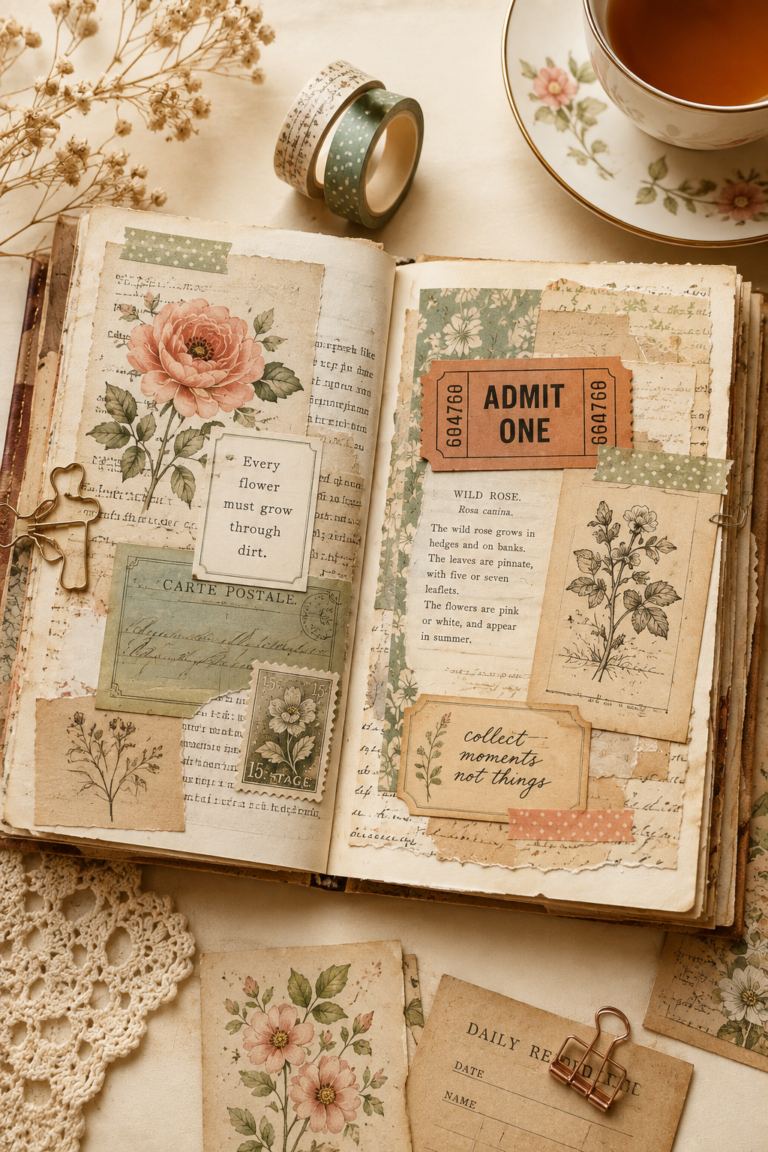
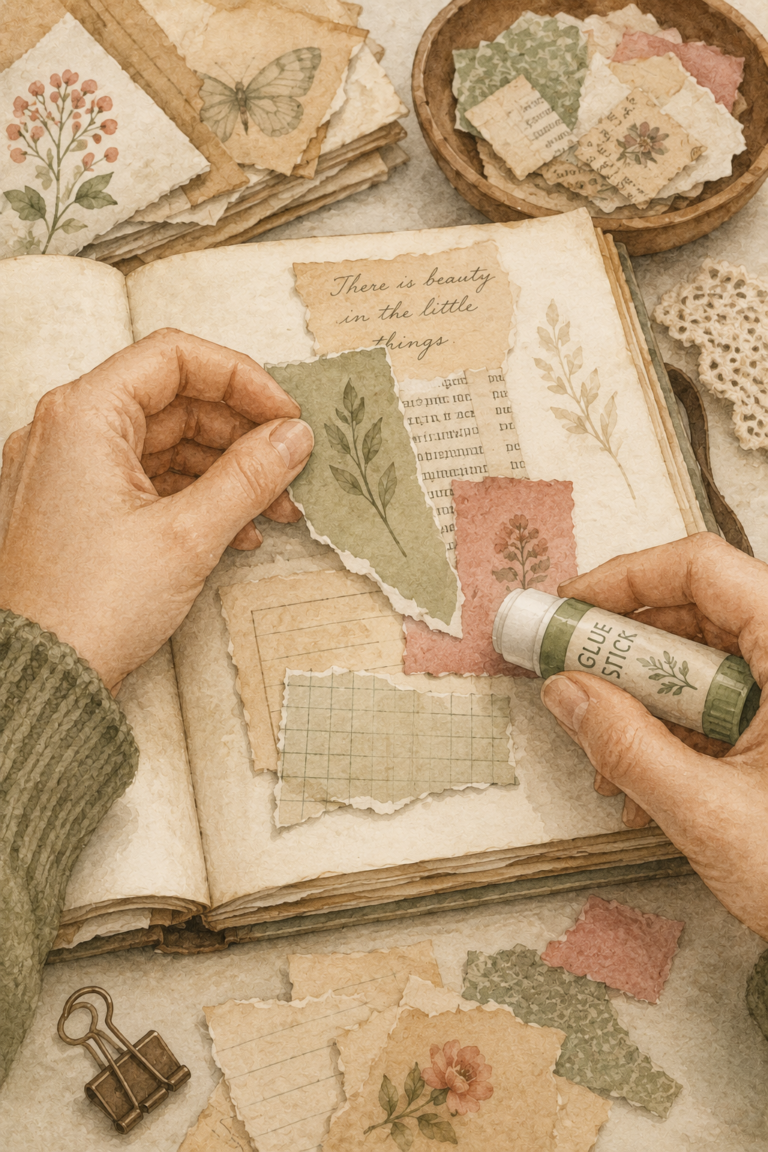
I get asked some version of this question a lot: “is junk journaling just scrapbooking with a different name?” I get why the confusion happens. Both hobbies involve paper, glue, photos or mementos, and a finished page you’re proud of. But once you’ve tried both, the differences are actually pretty clear, and knowing them upfront will save you from buying the wrong supplies for what you actually want to make.
I’m learning both of these alongside you rather than writing as an expert in either, so consider this the comparison I wish someone had laid out for me before I started.
🗂️ What Is Junk Journaling?
Junk journaling is a mixed-media, ephemera-driven craft. You’re filling a notebook (often a handmade one) with ticket stubs, washi tape, old book pages, receipts, stamps, ATCs (artist trading cards, small collectible-sized art pieces), and pretty much anything paper that catches your eye. There’s no fixed layout to follow. Pages are freeform, textured, and often built up in layers rather than planned out in advance.

Crafting Her Plans
Ready to plan it all out? We’ve got you.
Head over to the shop for printable planners and journals you can download and start using today.
Browse the shop →The appeal is largely in the process. You’re not necessarily documenting a specific event; you’re capturing a feeling, a colour palette, or just the pleasure of combining scraps that wouldn’t normally belong together. If you want a fuller walkthrough of how to actually start one, our beginner’s guide to junk journaling covers the basics step by step.
📸 What Is Scrapbooking?
Scrapbooking is photo-centric and usually chronological. You’re preserving a specific memory, holiday, or milestone, and the layout supports the photos rather than competing with them. Pages tend to follow more structure: a title, a date, a handful of photos arranged deliberately, and journaling that explains what’s happening in the images.
If you’ve browsed scrapbooking supplies online, you’ll have run into terms like “12×12” (the standard page size most scrapbook albums and paper are cut to) or “PL” (short for Project Life, a popular pocket-page scrapbooking style). Neither term is complicated once you know what it means, but they trip up a lot of newcomers who assume they need to learn a whole new vocabulary before they can start.
⚖️ The Core Differences
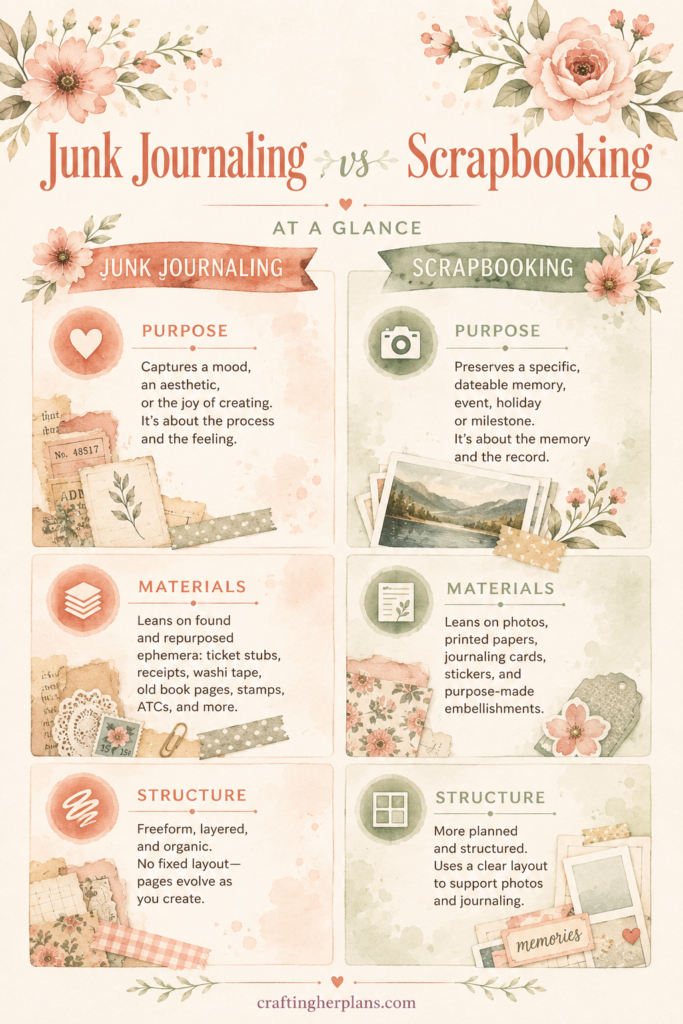
The clearest way I can put it: junk journaling is about the materials and the making, scrapbooking is about the memory and the record. That shows up in a few concrete ways.
- Purpose. Junk journaling captures a mood or an aesthetic. Scrapbooking captures a specific, dateable memory.
- Materials. Junk journaling leans on found and repurposed ephemera. Scrapbooking leans on photos, printed papers, and purpose-made embellishments.
- Structure. Junk journal pages are freeform and layered. Scrapbook pages usually follow a clearer, more planned layout.
- Starting point. A junk journal page often starts with “what scraps do I have that go together?” A scrapbook page usually starts with “what photos am I working with?”
Neither approach is more “legitimate” than the other, and honestly, a lot of crafters end up doing a bit of both once they’ve tried each one. If you like the idea of preserving specific memories but you’re drawn to the messier, mixed-media look, there’s nothing stopping you from scrapbooking with a junk-journal aesthetic.
🔗 Where They Overlap
This is the part that confuses people most, and fairly enough. Both hobbies use embellishments, stickers, and washi tape. Both involve cutting, layering, and adhering paper. Both benefit from a good pair of deckle-edge craft scissors if you want that soft, torn-paper border look on your pieces rather than a plain straight edge. And crafters moving between the two often find their existing toolkit (adhesive, trimmers, a decent pair of scissors) carries over with barely any new purchases needed.
The crossover skills also mean it’s genuinely easy to try both before committing to one. If you’ve got a stash of extra photos and a stash of paper ephemera, you could make one page of each this weekend and see which process you enjoy more.
🤔 Which One Suits You?
A rough (very unscientific) way to decide: if the phrase “I have a drawer full of ticket stubs and old postcards I can’t bring myself to throw away” describes you, start with junk journaling. If you’re thinking “I have three years of phone photos I want to actually do something with,” start with scrapbooking.
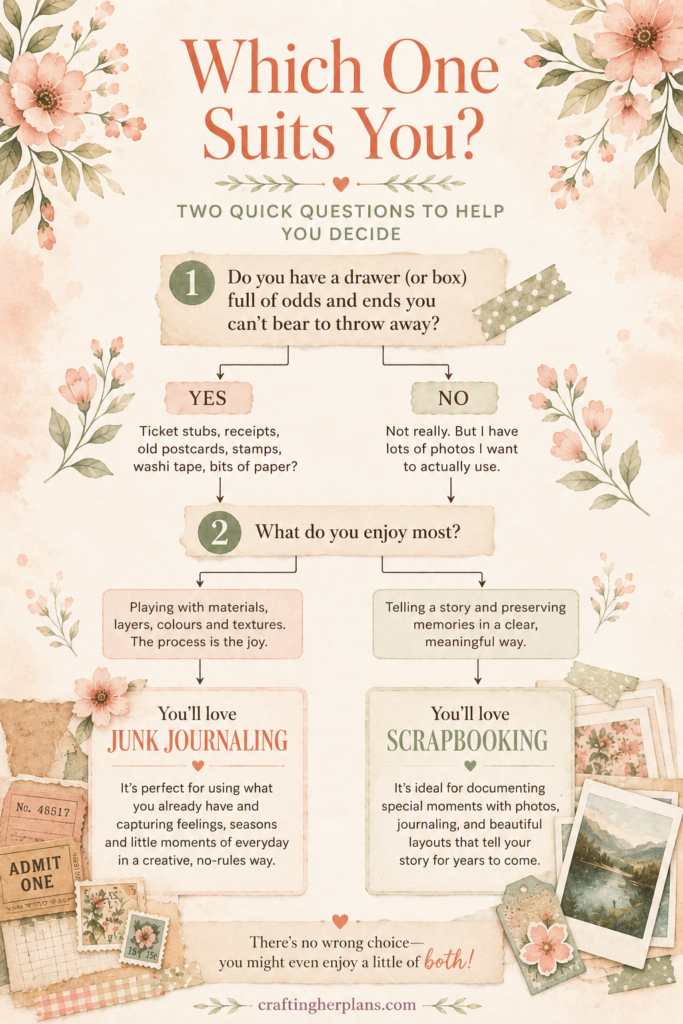
You can also let your supplies decide. If you’re working from what you already have lying around the house, junk journaling has a lower barrier to entry since so much of it uses things you’d otherwise throw away. Our guide to low-cost junk journal ephemera is a good next stop if that’s the direction you’re leaning, and junk journal supplies: what you actually need to get started will keep you from over-buying before your first page.
One practical note either way: however you land, plan for storage sooner rather than later. Loose ephemera and loose photos both have a way of multiplying fast, and something as simple as an accordion-style storage folder with labelled sections keeps both categories sorted without needing a full craft room overhaul.
✅ The Short Version
Junk journaling: mixed media, ephemera-driven, freeform, process over record. Scrapbooking: photo-centric, structured, chronological, memory over materials. Both are genuinely good hobbies, and neither one is the “correct” way to do paper crafting.
If this comparison has you leaning toward the junk journal side, our beginner’s guide to junk journaling is the natural next read. And if you want to try one page of each before deciding, that’s honestly the best way to find out which process actually holds your attention.