I’ll be honest with you: the first time I searched “junk journal supplies,” I closed the tab within about thirty seconds. Die-cut punches, three different weights of washi tape, a whole drawer of specialty adhesives, vintage ephemera packs that cost more than my weekly shop. It looked like a hobby for people with a spare room and a proper craft budget, not something I could start on a Tuesday evening with what was already in the house.
I’m writing this as someone still building her own junk journaling practice alongside you, not as someone who’s been doing it for ten years and has forgotten what it felt like to be confused by the supply lists. So this isn’t a guide from on high. It’s the list I wish someone had handed me before I nearly talked myself out of starting at all.
✏️ Why Most Beginner Supply Lists Get It Wrong
Most “beginner” guides aren’t really written for beginners. They’re written by people several years into the hobby who’ve forgotten which of their tools are essential and which ones they picked up along the way because they were fun, or on sale, or because another journaler recommended them. So the list balloons, and by the time you reach the bottom of it, starting feels like a project in itself.

Crafting Her Plans
Ready to plan it all out? We’ve got you.
Head over to the shop for printable planners and journals you can download and start using today.
Browse the shop →The truth is that junk journaling, at its core, is one of the cheapest craft hobbies there is. The word “junk” is doing real work in that name. It began as a way to repurpose paper that would otherwise be thrown away, and that spirit is still the fastest, least intimidating way in. You don’t need to buy your way into this hobby. You need about four things, most of which are probably already within arm’s reach.
What’s Your Junk Journal Starting Point?
Answer five quick questions about what you’ve already got and how you like to shop, and find out which starting style actually fits you, no guessing required.
📖 The Real Starter List (Just Four Things)
Here’s what you actually need before you make a single page.
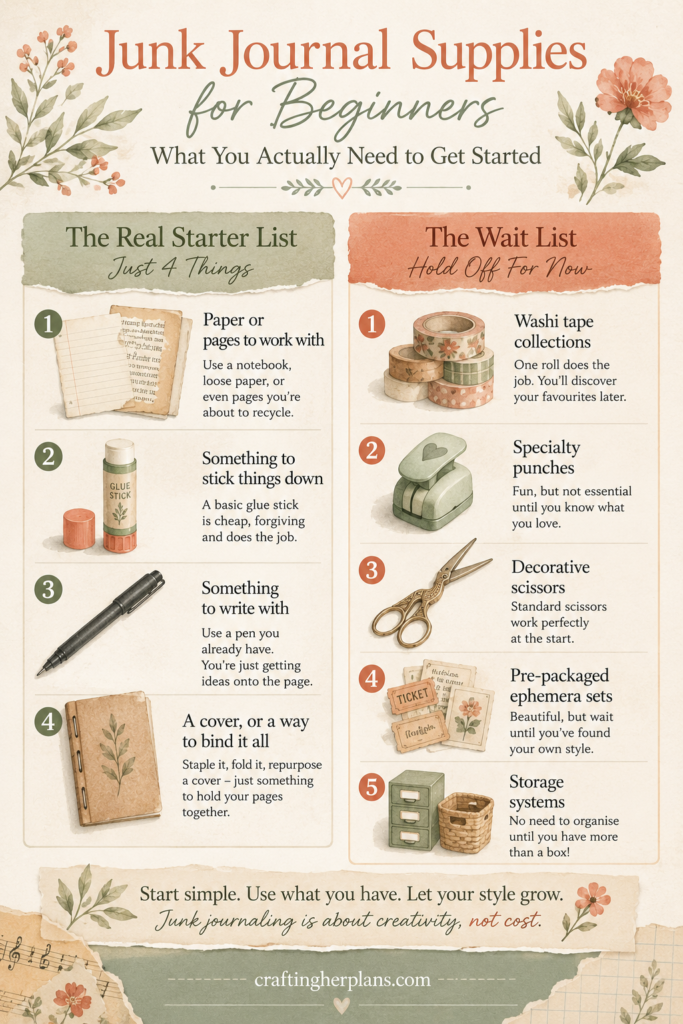
Paper or pages to work with. This can be as simple as a small notebook, a stack of loose paper folded and stapled together, or pages you make yourself from things you’re about to recycle anyway.
Something to stick things down with. A basic glue stick handles the vast majority of junk journal work. It’s forgiving, cheap, and widely available, and it will get you through your first several journals before you ever need to think about anything fancier.
Something to write with. A pen you already own is fine. You’re not choosing a signature tool yet, you’re just getting words and ideas onto the page.
A cover, or a way to bind what you’re making. This can genuinely be as simple as folding paper in half and stapling the spine, or repurposing a spare notebook cover you have knocking about. It doesn’t need to be sturdy or beautiful on day one. It needs to hold your pages together.
That’s the list. If you have those four things, you have a junk journal starter kit, whatever else Pinterest tells you.
A quick note on each one, because “what you already own” isn’t always obvious. Paper doesn’t need to be blank or new. Lined school notebook paper works, the backs of old printouts work, even torn pages from a book work once you get past the idea that paper has to look pristine before you’re allowed to use it. Your glue stick doesn’t need to be a craft-brand one either. A basic stationery glue stick from a supermarket does the job just as well as anything sold specifically for scrapbooking. And for binding, a stapler is a completely legitimate long-term method, not just a stopgap. Plenty of finished junk journals are stapled rather than stitched or bound, and no one making one for themselves is going to mind.
🕰️ What to Wait On Buying
There’s a longer list of things that show up constantly in junk journal content, and I want to be clear that they’re lovely, not essential. Washi tape collections are a good example. They’re genuinely satisfying to collect and use, but a single roll does the same core job as twenty, and you’ll get a much better sense of which patterns and widths you actually reach for once you’ve made a few pages and can see your own taste forming.
The same goes for specialty punches, decorative-edge scissors, and pre-packaged ephemera sets full of vintage-look tickets, stamps, and postcards. They can be gorgeous, and plenty of experienced journalers use them well, but buying them before you’ve made a single page means guessing at what you’ll like based on other people’s finished spreads rather than your own instincts. Give it a few sessions first.
🗞️ Free-First Sourcing: Look Around Your House Before You Shop
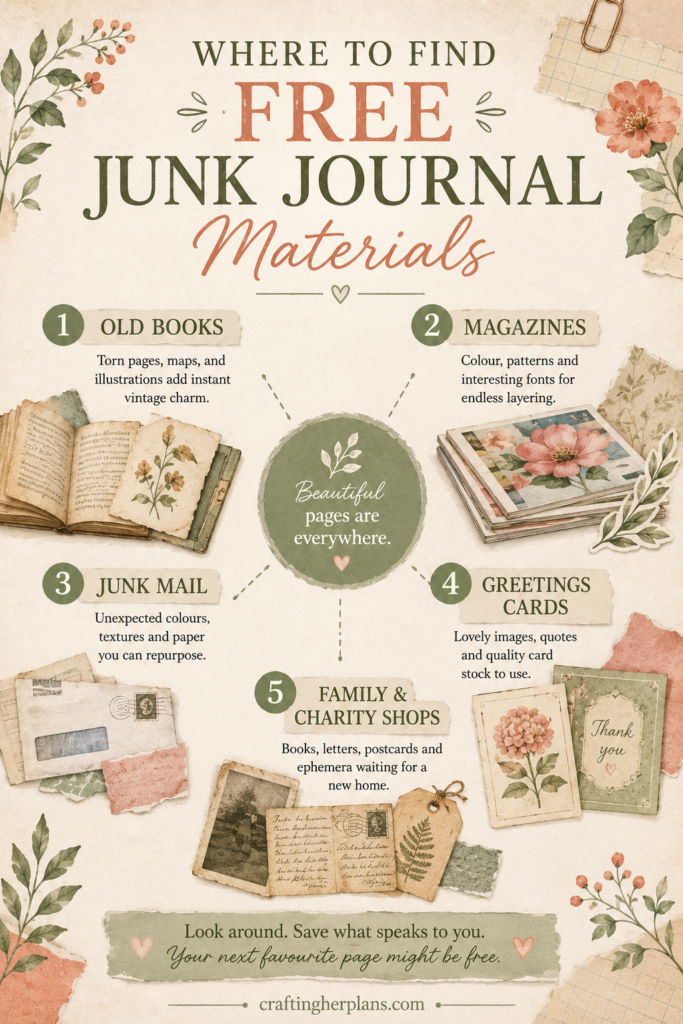
This is the part of junk journaling that made it click for me, and it’s worth sitting with before you spend anything. Old book pages, especially from books that are damaged or destined for the charity shop pile anyway, bring instant texture and a lovely aged look.
Magazines and old catalogues are full of colour, pattern, and interesting typography you can cut into. Junk mail, believe it or not, is a genuinely good source of paper with unexpected colours and textures you wouldn’t think to buy. Old greetings cards, used envelopes, and even the inside of cereal boxes for a bit of sturdier card all count.
None of this needs to be sorted or curated before you start. Keep a single box or folder for anything that looks interesting, and let it build up as you go. You’ll be surprised how quickly it fills, and how little you end up needing to buy on top of it.
It’s also worth asking around before you assume you need to buy anything at all. Family members often have boxes of old letters, postcards, or photographs they’re happy to let you take a few pieces from. Charity shops sell damaged or unsellable books for next to nothing, sometimes giving them away outright.
Local buy-nothing groups and community noticeboards are another good source, since paper ephemera is exactly the kind of thing people are glad to pass on rather than bin. None of this requires spending money, and all of it gives your pages more character than anything bought new and uniform.
🌱 Growing Your Kit as Your Style Develops
The mistake in front-loading your spending is that you’re buying for a style you don’t have yet. Once you’ve made a handful of pages, you’ll start to notice real patterns: maybe you gravitate towards botanical scraps and soft colours, maybe you like bold typography and stark contrast, maybe you’re drawn to pockets and hidden bits more than decorative covers. That’s the point at which buying something specific makes sense, because you’re buying for a taste you’ve actually developed rather than one you’ve borrowed from someone else’s finished journal.
I’m finding my own way through this same process right now, and my kit looks nothing like it did when I made my first page. That’s not a failure of planning. It’s just how the hobby is supposed to work.
When you do reach the point of buying something specific, let it be one thing at a time rather than a bundle. If you’ve noticed you keep reaching for a particular colour of washi tape in photos you save, buy that one roll rather than a set of twelve. If you find yourself wishing for a specific punch shape after using it on someone else’s page, buy just that shape. Buying slowly like this keeps costs low and also means everything in your kit earns its place, instead of sitting in a drawer because it came bundled with something you did want.
If you want a fuller walkthrough of getting started before diving into supplies specifically, our [beginner’s junk journaling guide] covers the basics of making your first few pages step by step.
✅ Your Quick-Reference Starter List
If you want the short version to screenshot or print, here it is.
Start with paper or pages, a glue stick, a pen you already own, and a simple cover or binding method. Add free materials as you find them: old book pages, magazines, junk mail, greetings cards, and anything else with texture or colour that would otherwise be thrown away. Hold off on washi tape collections, specialty punches, and pre-packaged ephemera until you’ve made a few pages and have a sense of your own style. Then build outward from there, one considered purchase at a time.
You don’t need a craft room or a shopping list as long as your arm to start a junk journal. You need curiosity, a bit of paper, and permission to make something imperfect. The rest tends to sort itself out.