You’ve decided you want a planner. You’ve scrolled through what feels like seventeen hundred options, and now you’re staring at two sizes that look very similar but somehow feel completely different when you hold them. A5 or A6 — which one is going to work for your life?
This is one of those decisions that seems small but genuinely affects whether you actually use your planner or leave it on your desk feeling vaguely guilty. I’ve been working through this myself, and what I’ve found is that the “right” answer has less to do with the size itself and more to do with where and how you plan. Let’s break it down properly so you can actually decide.
Understanding the Sizes First
Before we get into the comparison, it helps to know exactly what we’re talking about — because planner sizing can get confusing fast.

Crafting Her Plans
Ready to plan it all out? We’ve got you.
Head over to the shop for printable planners and journals you can download and start using today.
Browse the shop →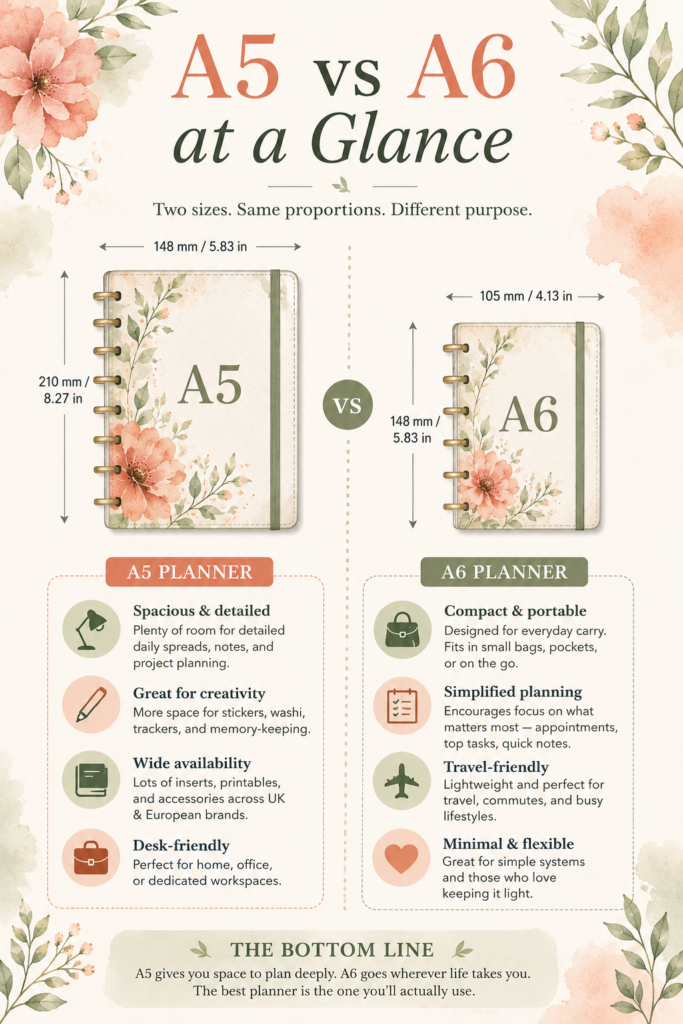
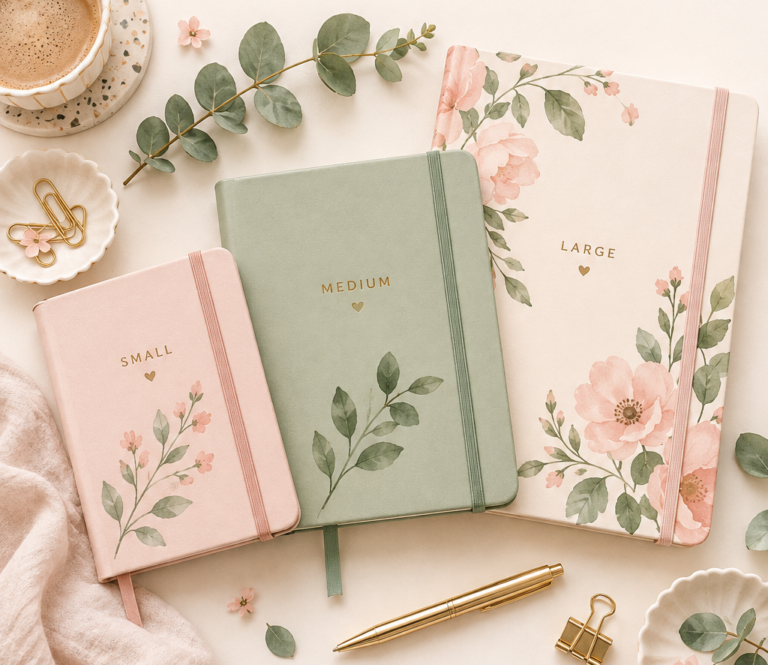
A5 measures 148 × 210 mm (or 5.83 × 8.27 inches). If you’re used to working with A4 paper, A5 is exactly half that. It’s the size you’ll find in a huge number of ring binders, notebooks, and printable planner systems, which means inserts and accessories are widely available, especially across UK and European brands.
A6 measures 105 × 148 mm (or 4.13 × 5.83 inches) — and here’s the neatest thing about these two sizes. A6 is exactly half of A5. So if you folded an A5 page in half, you’d have an A6. Same proportions, half the area. This matters because layouts translate cleanly between the two — an A6 weekly spread will look and feel structurally similar to its A5 equivalent, just more compact.
A simple way to hold this in mind: think of A6 as a shrunken A5. Everything fits, just smaller.
The Case for A5: Your Desk Planner
A5 has earned its reputation as the sweet spot of planner sizing. It gives you enough space to actually write without squinting, but it doesn’t take over your entire bag or desk the way an A4 notebook might.
What Makes A5 Work So Well
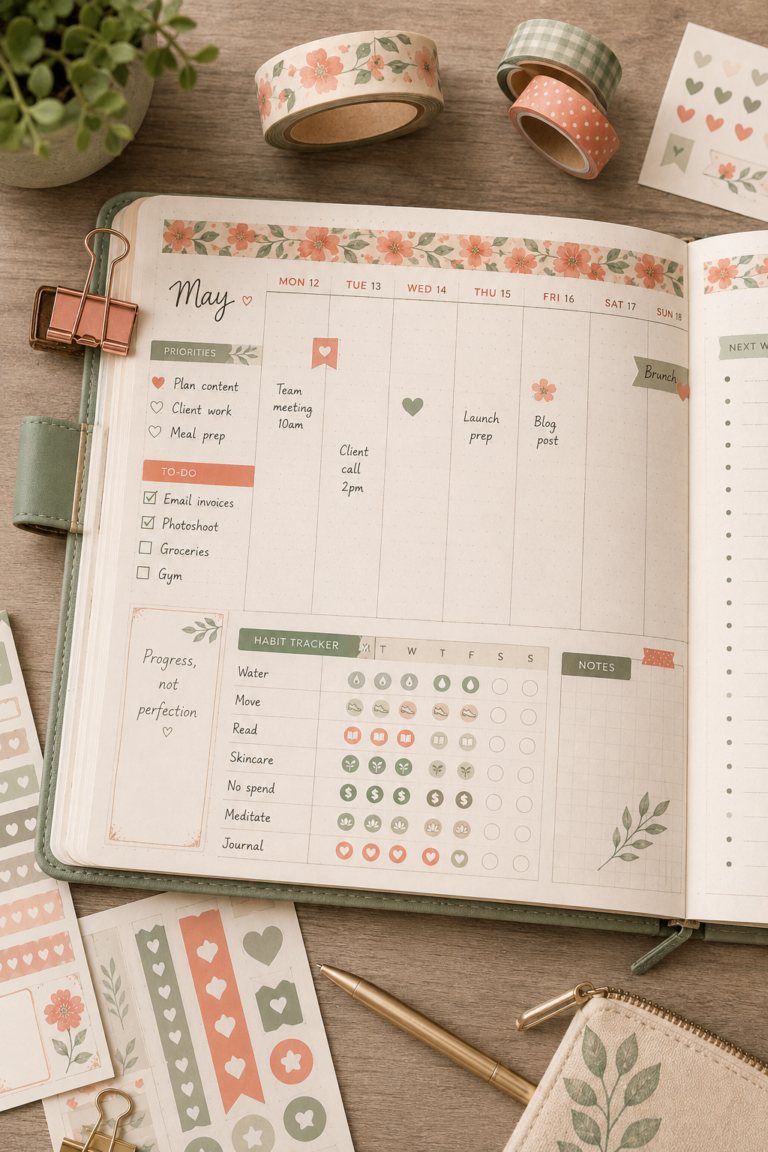
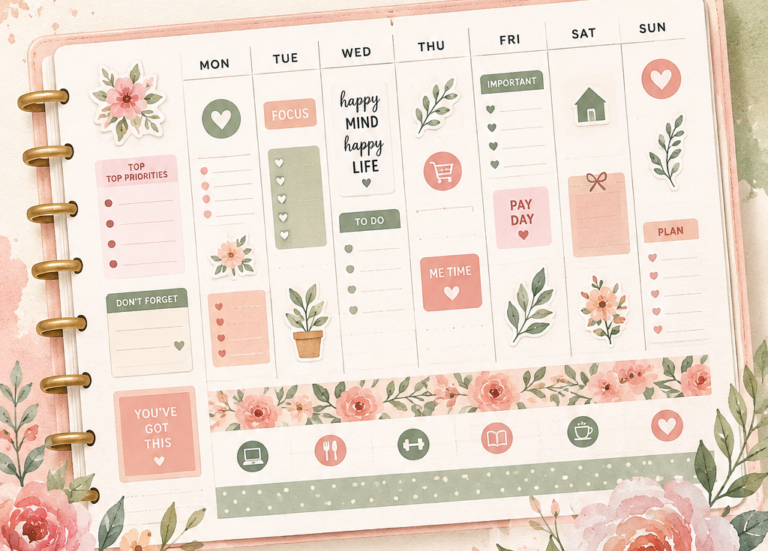
The page space is the obvious draw. A5 gives you room for detailed daily layouts — tasks, appointments, notes, maybe a little habit tracker squeezed in — without feeling like you’re fighting the page. If you like decorating your spreads with stickers or washi tape, A5 gives those elements room to breathe rather than crowding everything together.
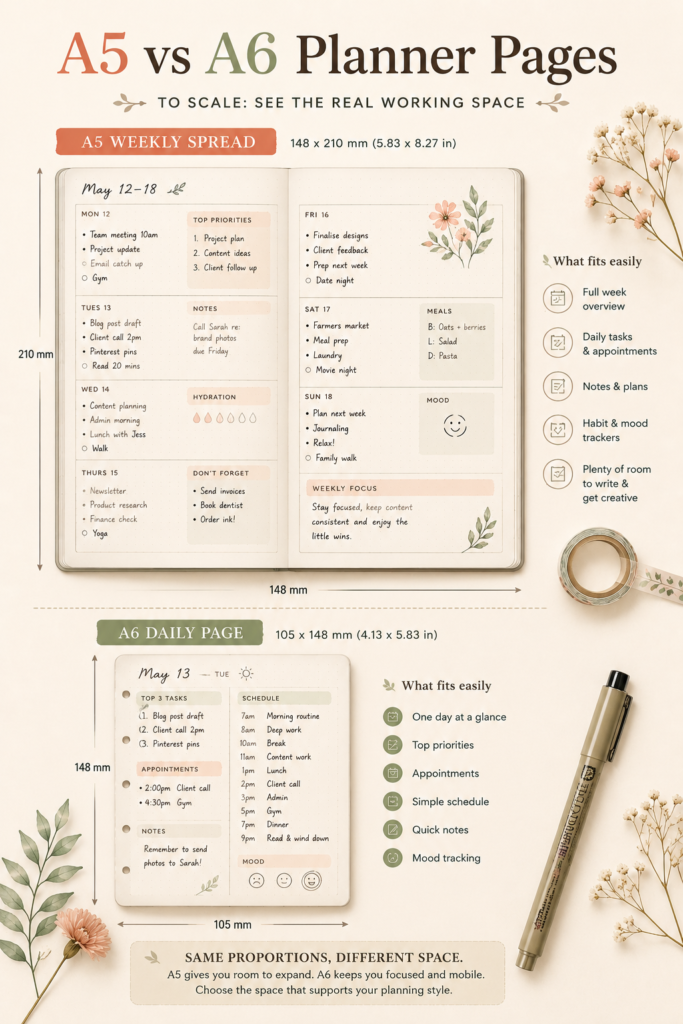
It’s also a very familiar size if you already use A4 printables or notebooks. Scaling your layouts down to A5 feels natural rather than like starting from scratch. Many UK planner brands design their inserts around A5 as a default, so you’ll rarely struggle to find refills, printables, or accessories.
Where A5 Falls Short
The trade-off is portability. A5 planners — especially ring-bound ones — are genuinely heavier and bulkier than their A6 counterparts. If your bag is on the smaller side, or if you commute and prefer to travel light, hauling an A5 around every day can start to feel like more effort than it’s worth. It’s not a dealbreaker, but it is worth being honest about how much you’ll actually carry it versus how much it’ll live on your desk.
A5 Is Probably Right for You If…
You do most of your planning at a desk or dedicated workspace. You love detailed spreads, structured layouts, or memory-keeping elements. You want plenty of room for notes, project planning, or journaling alongside your schedule. And you’re not precious about keeping everything in one bag-sized package.
The Case for A6: Your Everywhere Planner
A6 is the planner size that goes where you go. It’s explicitly designed for everyday carry — the kind of planner you slip into your coat pocket or tuck into a small crossbody without a second thought.
What Makes A6 Work So Well
Portability is the headline feature, but there’s something else worth mentioning: A6 naturally encourages simplified planning. When your page is small, you can’t cram forty things onto a day spread. You end up prioritising — appointments, top tasks, a few short notes — which some people find genuinely liberating. If you’ve ever felt overwhelmed by a too-detailed planning system, A6 has a way of stripping things back to what actually matters.
A6 also plays nicely with popular notebook formats. The Hobonichi Techo, for example, is an A6 notebook that’s built a devoted following precisely because it’s small enough to carry absolutely everywhere without thinking about it.
Where A6 Falls Short
If you have larger handwriting, A6 pages can feel cramped very quickly. Detailed spreads — the kind with colour-coded sections, multiple trackers, and decorative elements — are genuinely hard to pull off at this size. And if you love stickers, you’ll find that most sticker sheets are designed with A5 (or larger) in mind, so scaling down means cutting things up or hunting specifically for mini versions.
A6 Is Probably Right for You If…
You carry your planner in a smaller bag and hate being weighed down. You want a simple, lightweight system for appointments, short task lists, and quick notes. You travel frequently and want planning tools that actually fit your lifestyle. Or you’ve tried bigger planners before and found yourself leaving them at home.
A5 vs A6 at a Glance
Here’s a quick comparison to help you see the differences side by side:
| Feature | A5 Planner | A6 Planner |
|---|---|---|
| Paper size | 148 × 210 mm / 5.83 × 8.27 in | 105 × 148 mm / 4.13 × 5.83 in |
| Overall feel | Medium, desk-friendly, spacious | Very compact, pocket- and bag-friendly |
| Writing space | High — great for detailed spreads and notes | Moderate — best for short lists and appointments |
| Portability | Good in larger bags, bulkier in small ones | Excellent — designed for everyday carry |
| Best uses | Work planning, project tracking, journaling, memory-keeping | On-the-go planning, simplified systems, travel |
| Typical user | Someone who writes a lot and loves structured layouts | Minimalist planner or commuter who wants lightweight planning |
The “Which Size Is Right for Me?” Decision
If you’re still on the fence, here are a few questions worth asking yourself honestly.
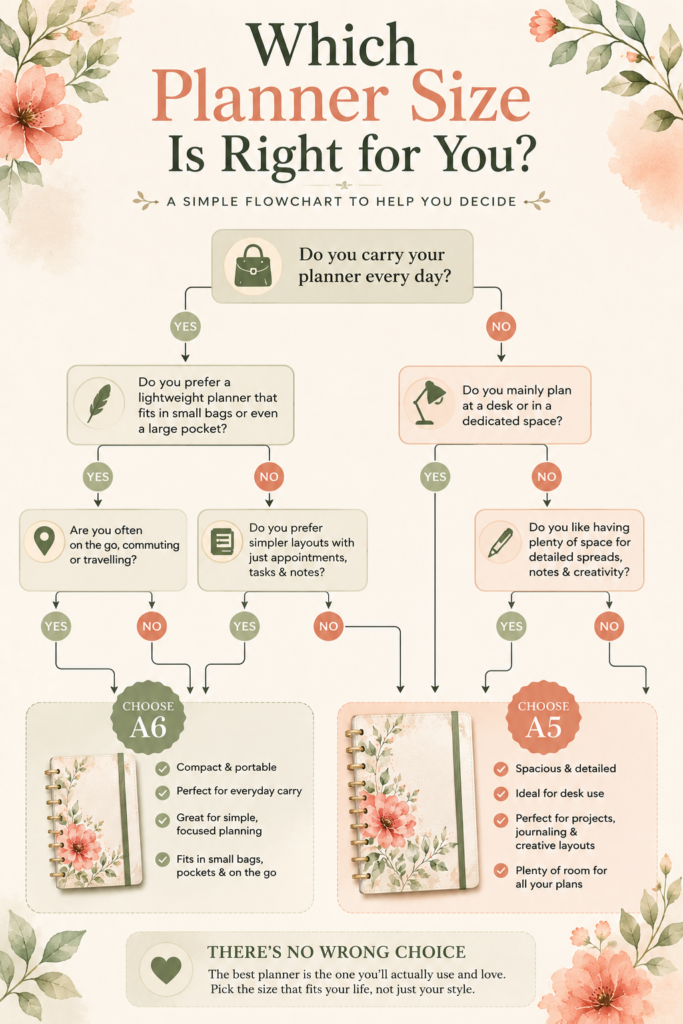
Where do you actually plan? If the answer is “at my kitchen table most mornings” or “at my desk at work,” A5 is probably your size. If the answer is “on the train,” “in waiting rooms,” or “literally everywhere and I hate carrying things,” A6 wins.
How do you plan? If you like detailed daily pages with time blocking, notes sections, and habit trackers, you need the A5 page space. If your planning style is closer to “write down the three things I need to do today,” A6 is plenty.
What have you tried before? If you’ve owned A5 planners and found them gathering dust at home, a smaller, more portable option might actually change your habits. If you’ve tried smaller notebooks and found yourself running out of space constantly, go bigger.
What’s your sticker and decoration situation? This sounds frivolous but it genuinely matters. If you enjoy planning as a creative, decorative practice — stickers, washi, coloured pens — A5 gives you room to play. A6 can work for light decoration, but it gets cramped quickly.
Can You Use Both?
The short answer is: absolutely, and a lot of people do. A fairly common setup is using an A5 planner as your “home base” — the detailed, thoughtful planning you do at the start of each week — and carrying an A6 as your everyday companion for capturing tasks, appointments, and notes on the go. The two sizes work together really naturally, and because they share the same proportions, your systems can mirror each other without much adjustment.
If you’re new to planning and not sure where to start, I’d lean towards A5 for your first proper planner. The extra space gives you room to experiment with different layouts and find what actually works for you, without the constraints of a smaller page forcing decisions before you’re ready.
A Quick Word on Printable Planners
If you’re considering a printable planner rather than a pre-made bound one, both A5 and A6 are well-supported sizes — particularly A5, which is probably the most common format for UK-based printable planner sets. You can print A5 at home on A4 paper and trim, or send files off to a print shop. A6 printables are a bit less common but absolutely exist, and you can always resize an A5 PDF if you find a design you love.
Making Your Decision
Here’s the honest truth: there’s no universally “best” planner size. A5 and A6 both do their jobs beautifully — they just do different jobs. A5 is your roomy, detail-loving desk companion. A6 is your lightweight, go-anywhere planning partner.
The question isn’t which one is objectively better. It’s which one fits the life you’re actually living, not the life you imagine yourself living. (We’ve all bought the ambitious planner and then left it on the shelf. No judgement here — I’m figuring this out alongside you.)
If you’re still genuinely torn, start with A5. It gives you more flexibility while you’re building your planning habits, and you can always add an A6 later once you know what you actually need from your planning system.
Enjoyed this post? Sign up for the Crafting Her Plans newsletter for more planner guides, layout ideas, and printable resources straight to your inbox.
Continue Your Journey
- The Complete Guide to Planner Sizes — A full breakdown of all the major planner sizes from pocket to A4, so you can see exactly where A5 and A6 sit in the bigger picture
- How to Start Bullet Journaling as a Complete Beginner — If you’re thinking about trying a more flexible planning system, this is the place to start
- Undated Planner Layouts That Actually Work — Practical layout ideas you can adapt to A5 or A6
- Junk Journaling for Beginners: What It Is and How to Get Started — A creative complement to your planning practice
- What Size Planner Do You Actually Need? A Decision Guide – A wider look at planner sizes if you aren’t sure that it is just a decision between A5 or A6.
Which size are you leaning towards — or are you already a committed A5 or A6 fan? Let me know in the comments!