Picture this: you find a gorgeous set of A5 inserts, you’re certain you own an A5 planner, and you click buy. They arrive, you line them up against the cover, and they’re a few millimetres out in every direction. Close enough to look right in the product photo, not close enough to actually work.
If that sounds familiar, you’re not doing anything wrong. “A5 notebook” and “A5 planner” are two different things that happen to share a label, and I’m still learning how to spot the gap before it costs money. Here’s what I’ve worked out so far.
📏 Why the Same Label Means Different Things
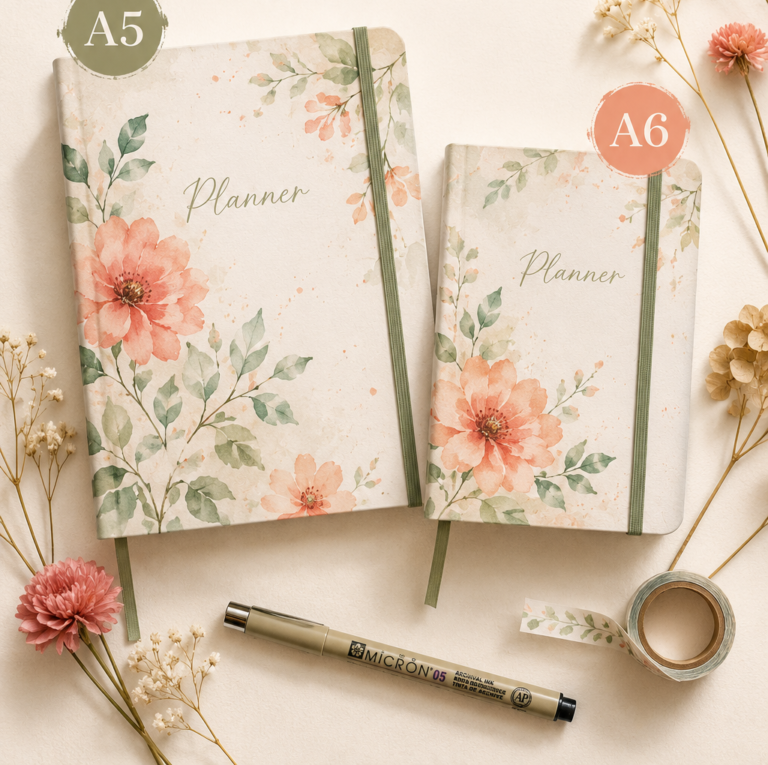
The A-series sizes (A6, A5, A4) come from an international paper standard. A5 is 148 x 210 mm, and every size in the series is exactly half of the one above it. That’s tidy, and it’s what most people picture when they see the label.

Crafting Her Plans
Ready to plan it all out? We’ve got you.
Head over to the shop for printable planners and journals you can download and start using today.
Browse the shop →The trouble is that very few notebook or planner makers stick to it exactly. A brand might call something A5 when it’s really 145 x 210 mm, or name a size after its own product line instead of the paper standard at all. The label tells you roughly where you are, not precisely. That’s why two products can both say A5 on the front and still not be interchangeable.
Planners add a second layer. Ring-binder systems often have their own named formats, like Personal, that were never based on the A-series in the first place. So when a listing says “Personal size” or “A5”, it could be pointing at a paper standard, a brand format, or a loose approximation of both.
📓 Where an A5 Notebook and an A5 Planner Diverge
Here’s the part that surprised me. Even when two products both honestly claim A5, they can differ in the ways that matter once you try to swap parts between them.
- Trim size: Notebook makers often trim a few millimetres off the ISO figure. Leuchtturm1917, for example, lists its Medium (A5) notebook at 145 x 210 mm, which is 3 mm narrower than a true A5 sheet.
- Binding allowance: A stitched or glued notebook spine takes up space that a ring binder doesn’t, and a ring binder needs room for the rings and punched holes.
- Margins and punch holes: Ring planner pages need that hole-punch margin. A notebook page doesn’t, so the printable area can end up in a different place.
- Cover overhang: The cover on a hardback notebook sticks out beyond the pages. A planner cover also sticks out, but by a different amount, and it has to cope with rings and thickness.
To see how big the gap between page and product can get, look at one A5 Filofax listing. It gives the closed organiser as 25 cm tall and 20.5 cm wide, with six 25 mm rings, even though the pages inside are 148 x 210 mm. The page size and the product size are two separate numbers, and only one of them tells you what an insert has to match.
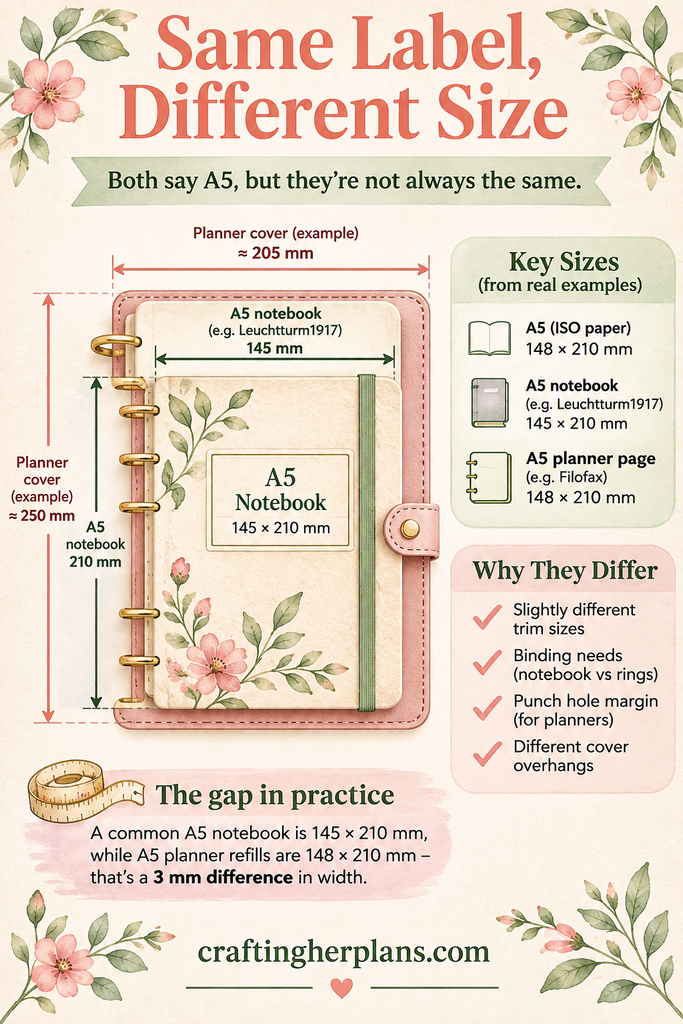
None of these differences is dramatic on its own. Stack two or three together, though, and an insert that looked like a perfect fit starts to rattle around, or won’t close the rings properly.
🔍 The Numbers From Real Manufacturers
I wanted to see actual figures instead of guessing, so I went through manufacturer and retailer listings and wrote down what they say. These are the dimensions as published, in millimetres, width x height.
| Size label | Product | Published size |
|---|---|---|
| A6 | ISO paper standard | 105 x 148 |
| Pocket (A6) | Leuchtturm1917 notebook | 90 x 150 |
| Moleskine Classic notebook | 90 x 140 | |
| Personal | Filofax refill page | 95 x 171 |
| B6+ | Leuchtturm1917 notebook | 125 x 190 |
| A5 | ISO paper standard | 148 x 210 |
| Medium (A5) | Leuchtturm1917 notebook | 145 x 210 |
| Large | Moleskine Classic notebook | 130 x 210 |
| A5 | Filofax refill page | 148 x 210 |
A few things jump out when you read it top to bottom. Both “Pocket” notebooks are narrower than a true A6, and they’re not the same as each other either. The Moleskine Large is exactly as tall as an A5 sheet but a full 18 mm narrower, so it’s easy to mistake for A5 on a shelf and wrong the moment you try to fit A5 anything inside it.
The Filofax Personal page, at 95 x 171 mm, doesn’t match any A-series size. It’s its own thing, and it’s a good reminder that “Personal” tells you nothing about A6 or A5.
I couldn’t find a firm manufacturer figure for a size called “Classic”, so I’ve left it out rather than guess. If you’re shopping for one, check the listing’s millimetre measurements and not just the name. Hobonichi also labels its Original as A6 and its Cousin as A5, but I’d check their site for the exact millimetres before buying anything that has to fit.
A quick worked example makes this clearer. Say you own a Leuchtturm1917 Medium notebook at 145 x 210 mm and you buy a printable insert pack designed for a 148 x 210 mm A5 page. The insert is 3 mm wider than your notebook, so it overhangs the edge and snags every time you open the cover.
Flip it around and the same pack cut down to fit the notebook might trim off a margin that the designer left for punching holes. Neither product is faulty. They were simply built to two slightly different definitions of A5.
🛒 What This Means When You Buy or Print
This is where a few millimetres turn into a real problem.
Inserts and refills: A ring planner refill that’s 148 x 210 mm with punched holes won’t sit properly in a 145 x 210 mm notebook, and a notebook’s pages can’t be re-ringed. Matching the name isn’t enough, so match the measurements and the binding style.
Covers and sleeves: A cover cut for one brand’s A5 notebook can be too tight or too loose on another brand’s A5. Soft covers and elastic closures are more forgiving, while rigid fitted covers are not.
Printables: If you print your own inserts, the paper size and the printer margins both matter. A printable designed for an A5 ring planner may land its content too close to the punch edge on a stitched notebook. Check where the file’s safe area sits before you print a whole stack.
Pen loops and add-ons: Elastic loops, pocket folders and clip-on accessories are usually sized for a particular spine thickness and cover height. They can look universal in a photo and still not grip properly on a different brand.
I’m a big fan of customising a planner, but I’ve learned to confirm the fit first. If you’re thinking about personalising your setup, my post on how to customise your planner has ideas that work whatever size you end up with.
📐 How to Measure What You Already Own
Before you buy a single insert, measure the thing you’ve got. It takes a couple of minutes and saves a lot of faff.
- Page width and height: Close the book or planner and measure a single page with a ruler, in millimetres. Don’t measure the cover, as it sticks out past the pages.
- Spine or ring size: For a ring planner, note the ring diameter. For a notebook, measure how thick it is when closed.
- Hole positions: If it’s a ring binder, measure the distance between holes and from the top edge to the first hole, so you can compare with a refill’s punch pattern.
- Write it down: Keep the measurements in your phone notes or on the inside cover. Next time you’re tempted by a sale, you’ll have the numbers handy.
If you’d rather work it out with your fingertips, a spare piece of paper trimmed to your measurements makes a handy template. Hold it up against the dimensions in a listing and you’ll see straight away whether it’s likely to fit.
✅ A Quick Check Before You Buy or Print
Here’s the short checklist I run through now, and it’s worth keeping on your phone.
- Is the size given in millimetres, not just a label?
- Does the product say what it’s designed to fit (a particular brand, ring size or binding)?
- Does the insert have punched holes, and do they match my planner’s pattern?
- If it’s a printable, have I checked margins and the safe area?
- If the listing has no measurements at all, can I ask the seller before ordering?
That last one is underrated. A quick message to a seller is quicker than a return.
🔗 Where to Go Next
This post is about why labels and fit don’t always line up. It isn’t trying to tell you which size to pick.
If you want the full size charts, my planner sizes guide lays them out in one place. And if you’re still deciding between formats, What Size Planner Do You Actually Need? A Decision Guide walks you through choosing one properly.
If you’re comparing two particular sizes, the A5 vs A6 planner post is worth a look. And if your project is a bullet journal rather than a ring planner, my roundup of bullet journal notebooks is a good starting point.
🌸 The Short Version
Same label doesn’t mean same size. Trim, binding, margins and brand habits all nudge the real dimensions around.
Measure what you have, read the millimetres on what you’re buying, and treat the label as a clue instead of a promise. I’m still learning this as I go, so if you’ve been caught out by a mismatched size, I’d love to hear how you fixed it.